Thursday, 2 February 2017

B2B Marketing Strategies – The Bitter Business

B2B Marketing Strategies – The Bitter Business


In the world of B2B marketing strategies, CMO’s and marketing leads are finding out that there is allot more to them than just content and SEO.
Social media marketing companies seem to trot out the well worn lines of, you must create a library full of content, recalibrate your SEO, share the content on the social networks, and HEY PRESTO. Your business will have a flow of low cost inbound leads from buyers interested in buying your product or service. The logic around a content lead strategy for lots of businesses stacks up as the lower cost of an inbound lead against an outbound lead is sizeable, making it attractive to invest in SEO, articles, blogging and content.
b2b-marketing
So it can be easy for any marketer to assume that we all use social media. Most marketing people are active on the social networks as it forms part of marketing tactics and we also have to be up-to-date on latest trends. However, this is not the case for lots of senior business people and buyers. I have worked with lots of CEO’s who do not have profiles on LinkedIn or Twitter. Others in senior positions are not actively engaged with social media to get a result on trying to build awareness for your brand or even social selling tactics.
What lots of social media agencies will never tell you is that an inbound strategy does not work for all market sectors and can be in fact a waste of money, resources and time. For certain B2B companies operating in certain markets or industries, the reality is the target buyer audience can be too small or the products or services too specialised to be worth over investing in SEO, Google Adwords or Content Marketing. If your business is a new or disruptive product then maybe buyers is not yet doing keyword searches on Google for the solutions you sell.
You see most inbound marketing tactics try to hit multiple keywords or topics to engage buyers. Most of these tactics really are inexpensive to tee up and implement but the audience engagement is not an exact science (you can’t stop anyone reading your articles). So it does take some time to refine your tactics to narrow down sell-to leads.
When articles or blog posts are ranked in search engine results, the relevancy to the topic is mainly down to the keywords it has been optimised for. If your target is HR directors in the banking industry in Ireland then content and even paid advertising cannot be specifically targeted at them(you cannot control who reads or clicks). There are exceptions like social selling tools like LinkedIn or Connectors Marketplace where you can specify buyer profiles.
Let me be clear, I am not for one second suggesting B2B marketers should discount social media as part of their marketing strategy. The thing to remember is to keep the purpose and goals in perspective, don’t get carried away by stories, statistics and advice that may or may not be relevant to your business proposition.
To make social media pay, you should:
• Evaluate the social platforms for their fit to your marketing goals
• Can you feed them with quality content and informative articles
• Train up the sales team in social selling so they can use social media to nurture relationships

So when does inbound marketing have limited returns?

  • The buyer is a specific person within that company: If one buyer has the authority to purchase your product with little influence from other stakeholders as it is not a critical purchasing decision (e.g. paper) then it is a challenge to engage this person with inbound marketing alone.
  • The target market is small: When the target prospects are defined by location, company size or a single buyer (see above) in a company, the list of prospects can be very small. My own rule of thumb is if your prospect list is less than 1000 companies then a heavily weighted inbound strategy may only be helpful to raise awareness as the buyer will probably be targeted via sales calls.
  • Disruptive technology or products: Where inbound excels is when the buyer is on a journey of self discovery (reading articles, whitepapers or engaged with social conversations) and where they understand the problem and the solutions. When a product is disruptive in nature a business may have to create demand as few buyers will be seeking out information. Inbound marketing does NOT create demand, it harvest levels of buyer interest based on keyword nets thrown out by marketing content.
The reality is that for some companies, the keyword net on Google searches and the social networks is simply too small to gather enough sales leads. This leaves options like outbound sales and referrals to harvest leads. We know referrals have a high conversion rate but this is not a repeatable sales process. So this leaves outbound selling (combined with social selling) makes for a repeatable, scalable sales process.
As someone who champions inbound marketing, social selling and good old fashioned sales techniques, I have to be frank and say if your products or services meet any of the criteria I wrote about above, then inbound marketing alone as a lead channel will have limited success. So contrary to what lots of social media gurus preach, inbound marketing is only part of the solution and it may not be a lead generation machine to feed sales.
b2b-marketing-strategy-options

So what marketing and sales strategies will work?

Marketing and sales leaders spend endless hours asking and answering this very question, “Where and how do we engage the right prospects?” The good news is there are still lots of options when it comes to reaching B2B prospects.
Embrace outbound prospecting: Hire in sales people who can pick up the phone and prospect AKA cold call. A business can now subscribe to automated lead generation platforms to give you large lists of prospects based on titles, industry and location with full contact details (email and telephone numbers) including social media profiles for social selling engagement. This works great for SaaS companies and companies with defined sales processes.
Still some life in events and trade shows: Attending events can be another way to connect with your target prospects and meet them in face-to-face. This can be a very personal approach that creates trust and builds relationships. The big barrier  is that events cost money, have higher cost per lead, take time to plan and are they cannot scale in any major way.
Industry Webinars: If your own marketing reach is too small to make hosting your own webinar an option, then maybe consider trying to find a market research company, an industry publication or forum or a contact where you can piggy bank on their webinars to get access to their audience. It does take effort but can be a great way to grow a prospect list while providing valuable content to generate more awareness.
Customer Referrals: Some businesses do manage to generate a large portion of their leads via customer referrals and word of mouth. But a note of caution, this tactic is difficult to forecast and scale. Also from a sales process, it is hard to have a programmatic approach to word of mouth referrals. Even formal referral programs usually have low level of leads in certain B2B sectors.
Exposure in publications: Online and print publications are a B2B marketing channel worth exploring. Product reviews, news and interviews can be a great way to reach an audience and connect with prospects
We must all accept that the buyer’s journey is changing. Yes, social media marketing agencies are right when they say business buyers are increasingly relying on social media, social conversations, social reviews and other content as a means of gathering information about vendor solutions. But regardless of what B2B marketing strategy you pursue to generate leads or sales, there is still a huge place for direct human contact via well trained sales people. In the sales process there will always be a place where questions will best be addressed in a personal way especially in higher value deal sizes.


Monday, 24 October 2016

Is Digital Selling The Ultimate Sales Channel?

In a world where generating sales leads is now the biggest challenge facing companies, could digital selling including social selling be the ultimate sales channel for the foreseeable future. In the digitally connected world, to attract buyers attention, a business has to develop trust, this means starting with authentic interactions and engaging on social media.
Digital-Selling
There are lots of definitions as to what “Digital Selling” actually entails, but the main point to get across is that digital selling is about creating cohesion between sales and marketing in the areas of content marketing, inbound marketing, social selling, data, social listening and insights which are mapped to the buyer’s journey. All these “online” elements when structured together can be used to create a Digital Selling strategy. It is not just about the sales team trying their luck with social selling or the marketing department producing a stream of content. To make it work, leaders must create an organisational structure around the social media channels and KPI’s to measure buyer engagement.
Many companies feel that in-house created content reach (views, likes, downloads)  is the ultimate measure for buyer interest, however other measures like social reach, buyer connections, sales person profile/company page views, questions posed, questions answered and conversation engagement are other key measures worth considering. A key part of any Digital Selling strategy is everyone in sales and marketing should be involved in the creation, organising and sharing of content.  To succeed with the socially influenced buyer, remember companies with the best stories shared will win. In a way, a business needs to have a publishing department, one that concentrates on creating volumes of content or research which is mapped to a buyer’s journey

Let’s take a deeper look at Digital Selling

Digital selling is the use of social selling (1:1 buyer engagement on social channels undertaken by sales people) combined with the use of digital assets (videos, articles, whitepapers, case studies, infographics, webinars, online presentations) and supported by sales intelligence (data, ideal customer profiles, insights, triggers, CRM, social listening) to generated leads and revenue.
In a way, digital selling could be termed “closed loop selling” as it about matching your sales strategy to buyer behaviour which we now know is increasingly influenced by social media.  So in a way, it takes a holistic view of the buyers journey to bring together the assets and actions in order to be valuable to buyers on their journey, one that ultimately leads to better engagement and ultimately more sales.
There are many compelling reasons around this strategy, mainly driven by the fact that buyer behaviour has changed and there is no old way of doing things as most sales tactics such as cold calling have diminishing returns. Today’s connected buyer is more informed than ever before plus they have become expert at tuning out to all those interrupter sales strategies and tactics that worked so well in the past. They seek not to be sold to. They seek advice, knowledge, insights and someone to guide them to the right purchase decision.
The whole digital sales transformation is in full swing around us, whether it is inbound marketing, freemium models, social selling or consultative sales models, it is digital selling to step forward and take centre stage.
Digital selling is fast becoming main stream as forward thinking SaaS companies lead the way whilst many smaller or medium sized businesses must watch and learn fast.
digital-selling-strategy

So where does social selling fit in?

As I stated previously, Social Selling is the key sales person’s activity within Digital Selling. Again, there are many definitions but my own one is “Social selling is the sum of connected actions shared online when experienced by customers/potential customers will influence their awareness and consideration for your business.
It boils down to the influence an individual sales person can have on customers and prospects’, by sharing content on social networks which is consumed, shared, commented on and visible across multiple networks.
Sales teams deploy social selling as an activity that is proven to be valuable (sharing insights, articles, expert advice) to buyers as they move through the awareness, consideration and selection stages on the new buying journey via social media.
Social Selling uses three key elements: namely Insights, Triggers and Referrals to map the buyer’s journey, then supports these elements with articles, curated content, videos, whitepapers etc to engage a potential customer.
Summary:
A digital selling strategy acknowledges that the connected buyer needs education but they educate themselves. They have become blind to advertising and ignore slick marketing material. They value peer recommendations over sales jargon and they complete a large part of the buying process without sales interactions or taking calls. They want to be guided and expect insights from experts with an understanding of their business not yours.
So, pause, listen & engage to nurture relationships via social networks. Modern sales leadership know that the key to sustained success is to include digital selling alongside social selling and social media marketing so all departments and all employees can play their part in the online customer engagement process. When sales and marketing work together to engage someone from prospect to customer, the whole business from top to bottom can stay on the same page with critical contacts, conversations, conversions while measuring the resulting ROI. That is Digital Selling.


Is Digital Selling The Ultimate Sales Channel? – The Bitter Business


Monday, 17 October 2016

Social Selling Training Programs

ADAPTABLE, BUSINESS SCHOOL STANDARD TRAINING, CUSTOMIZABLE FOR ANY INDUSTRY OR COMPANY STRUCTURE

Small, mid-sized or Large Corporate
Add our industry validated digital programs to your Skillset to target new markets, increase revenue and establish a competitive edge.


TRAINING FOR SALES PROFESSIONALS

TRAINING FOR SALES PROFESSIONALS

Today’s buyer is digitally-driven, mobile, socially-connected, empowered with unlimited access to real-time information about business problems, products, companies, competitors — about all sorts of things. Also, buyers don’t have to rely on brands, interruption marketing or companies or salespeople for information, because they can find that freely on the web.
Prospects can compare your product or service and buy from the competition without you even knowing they exist.
The buyer’s journey has changed so sales leaders, mangers and sales professionals need to understand how they can connect to and leverage these habits.
The DSI course on “Social Selling for Agents” has been developed in conjunction with sales coaches, business schools and over 5000 hours of research. It is designed for sales management and sales professionals to learn how to function in the digital space. Full Course Information.

TRAINING FOR SALES AND MARKETING LEADERS

The digital connected world has turned the traditional sales funnel, on its head. Old sales and marketing tactics have diminishing returns. Change in sales methodologies has accelerated at dizzying proportions. We are in a constant state of disruption. Just when we think we’re getting to grips with the new, it’s already old.
The most significant change in our world is that digital connectivity has put power in the hands of the buyers. Instead of being passively influenced by marketing and sales, they actively search, research and compare.
In this course, sales and marketing leaders will learn how Social Selling can used as a vehicle for sales transformation and how to evaluate, support and integrate social selling from a leadership perspective to become a social business. Also why social selling is an essential requirement for sales teams, and how the relationships that are created and nurtured within social media will help you grow and sustain your business.


TRAINING FOR SALES AND MARKETING LEADERS

THE DSI TRAINING MANTRA

The use of social networks for sales is no longer optional for business. It’s a powerful strategy that can help sell ideas, establish credibility, attract and win customers. It is the result of the profound integration of social media into how we conduct our lives for business and pleasure. The buyer’s journey has changed in the digital world so sales and marketing professionals need to understand how they can connect to and leverage these habits.
The DSI programs are focused on providing excellence in design, transformational learning experiences and quality customer service. So we have built learning programs that brings thought leadership for sales and marketing professionals around sales tactics, lead generation, reducing cost per lead, prospect engagement, sales pipeline and revenue.
The tangible return on investment has been evidenced repeatedly in our work with companies both large and small to bring an untapped source of competitive edge for your business

ONLINE COACHING – ROBUST CONTENT 24/7

The always on access to course material and the cost effectiveness of electronic content can both be critical to managing an investment in training your team. At The DSI learning becomes real when applied with the help of seasoned coaches that will demonstrate and inspire social success. Each online session covers a different topic from our comprehensive course material.
Students can learn, ask questions and engage in dialog with peers. These virtual sessions will accelerate learning through reinforcement and are highly interactive. This ensures all training members are on-board and actively participating in their training and development.


 Social Selling Training Programs

Thursday, 13 October 2016

The Key Elements of Digital Sales Transformation – The Bitter Business

The Key Elements of Digital Sales Transformation – The Bitter Business


I think we all have to acknowledge that the sales profession is going through a major transformation. Social media, mobile, and digital information means buyers are better informed and rely less on sales people in the purchasing journey. And that same purchase process has become longer and even more complex within the consultative type selling models.
digital-sales-transformation
Digital Sales Transformation could be defined as “How sales capabilities and competences need to be developed to address the “Connected Buyer”, meeting changes in the industry facilitated by digital tools”. In a nutshell, transforming sales performance will involve a combination of better training for the new age sales person, better use of technology/data, and better customer content to drive conversations.
It is not just another business buzzword to be bandied about at management meetings. The buyers journey is changing fast (wait till Millennials make up the majority of buyers!!) so it’s important to focus on real business and customer challenges and changes now.  Now it the time to have a clear approach, prioritise action and involve the entire marketing and sales force in any digital transformation process. Where to focus in terms of market arenas (capture more business in the short term), what is the right offering (product to market fit) and value proposition for these markets, and how to manage customer relationships and sales to win in the digitally influenced market, are some of the questions to be answered.
The digital tools I mentioned above as part of the definition of sales transformation are invading the business ecosystem, bringing with them major changes in the way we work, communicate, and sell but most importantly the change in how customers buy. As with most things in like, this has brought both opportunities and challenges, and has triggered the Digital Transformation within companies for all aspects of customer touch points.

Sales enablement needs to focus on “value messaging”, “social selling” and “consultative selling” skills training.

The starting point is focused on improving the business awareness of the sales teams because the old sales methodology of selling product features to increasingly more sophisticated buyers will not cut the mustard.  Sales professionals must be able to map the buyer’s journey, understand “Ideal Customer Profiles”, deliver compelling insights (using a variety of content) to differentiate themselves (Why me!!)  And communicate this value to close more business without being dragged into the pricing discount race. So sales enablement leaders are looking to “value messaging”, “social selling” and “consultative selling” skills training using social networks to help the sales force communicate and influence buyer perceptions of value.
The development of these new sales or marketing competencies revolves around the capacities for sales people to be more agile, buyer-centred, innovative, connected, aligned and effective with present and future changes in mind. The digital sales transformation will have many connected goals, but in the end striving towards optimisation across sales processes, support divisions and the business ecosystem of the always-connected customer where building the right bridges with the right people at the right time during the buyers journey is the key to success.
A reminder of the buyer’s journey: Today’s buyers, from consumers looking for a new car to company buying committees purchasing software, can easily research and compare products thanks to the visibility offered up from a host of social networks.
digital-selling-impact
The positive news is that with re-tuning for this digital era, sales teams have significant capabilities to impact the buyer’s journey to become a valuable influencer, aided by big data, digital selling tools, and organisational changes to the buyers’ growing level of self education.

The major themes of Digital Sales Transformation:

  • Find growth in arenas before your competitors arrive
  • Sell the way customers want to buy
  • Optimise sales operations and digital tools
  • Sales and marketing as a unified team who challenge the status quo and manage revenue performance
  • Empowering sales enablement to make change happen
Look Ahead
The whole purpose of sales transformation is to drive profitable growth within companies. It is about using insights, social signals and data to anticipate buyer interests and map out where untapped potential lies. They focus on being useful and valuable to buyers in order to lock in new customers first (and out manoeuvre their competitors).
Find growth in Social Data
The use of social data as part of the sales engagement plan can open up amazing sales opportunities. Companies from all sectors, B2C and B2B can build insights from a wide array of internal and external sources and create tailored selling propositions based on prospect personalisation. However to maximise the benefits of social data, social selling needs to be at the very heart of the sales culture.
Selling that matches the Buyer’s Journey
Generation connected customers have discarded their participation in traditional sales models. They want self-determined, more seamless, and rewarding buying experiences; they want more of the right information at the right time, more value from sales interactions and they want on channels of their choosing. For sales leaders, getting their heads around this is hard enough but transforming sales models in mature or emerging markets is a major challenge. But leading sales organisations are finding ways to improve digital channels, the availability of content plus maximising direct and indirect channels. Using social data and social selling they are cracking the code of how to integrate them all. No company can win today using old sales methodologies, so the smart ones are using transformation to manage a multi-channel approach to ensure consistency, maintaining close contact with customers and raising the sales bar. The best sales leaders are transforming inside sales and field sales, integrating online with inbound with social selling, orchestrating direct and indirect sales and marketing teams and using data to drive activity.
The best test and tweak constantly to bring value to the buyer’s journey and turn conversations into sales conversions. They embrace social networks, mobile and understand the benefits of building deeper customer relationships across all platforms with quality content. Finally, they recognise that digital is an additive process, so they work hard at seamless integration with every other sales channel to win.
Mapping the Customer Decision Journey

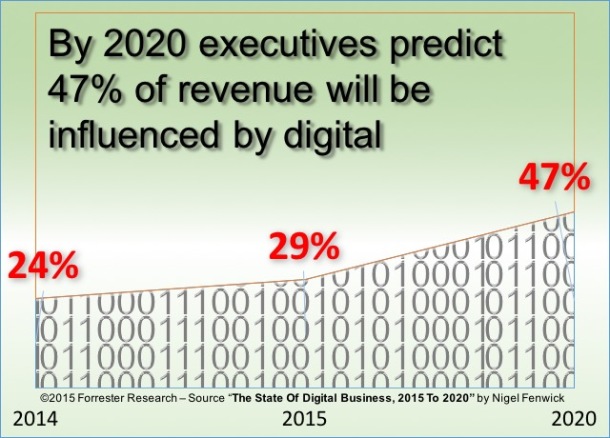
“12% of all B2B sales in the US will take place online by 2020 – Forrester”

 digital-transformation
75% of purchases now start with an online search by the buyer. 90% of decision makers say that they never respond to cold outreach – (Harvard Business Review).  More than half the sales process has disappeared. B2B buyers are 57% of the way through their purchasing decision before they ever engage a sales person. In fact, a B2B customer will regularly use different interaction channels throughout the purchase process. The mapping of Ideal Customer Profiles and the Customer Decision Journey  around which marketing and sales collaborate has become standard practise in many progressive sales organisations. They also know that this journey is different by customer segment/profile, with varying needs and expectations at each point in the journey.
It is about ensuring the sales teams reaches the right people at the right time with the right offer.
Innovate Inside Sales
Cold calling is dying fast and some companies are still flogging dead horses. Sales transformation success can pivot on changing the inside sales approach. The leaders of the successful inside sales forces have recognised this. They use social selling to nurture customers early, long before any sales pitch. They seek to bring value and be a trusted source of information to unlock growth in key accounts which is the prerequisite for the consultative sale. Regardless of size or industry, there are always new ways for business development people to engage new customers.
 Blend your Sales and Marketing Engine
In transforming the sales engine, business leaders must ensure that marketing and sales teams work together to extract the full value of every piece of data or customer touch point. Despite their co-dependency, it can seem like marketing and sales are marching to a different tune. Successful sales leaders work with marketing (and vice-versa), benefiting from the market insight skills it brings and feeding these insights to the sales engine to maximise every campaign or lead. Research has shown that when the two teams collaborate to drive sales and revenue, companies enjoy higher sales growth.
Use Technology as an Advantage in Sales
The use of digital sales tools must evolve to keep pace with customer preferences.  Part of the role of sales enablement is to ensure the investment enables success instead being viewed as another big brother information tool. Appoint an owner whose focus is on acquiring and implementing the right tools to deliver the returns on productivity or performance the business expects.
Sales Transformation is about having the right Talent to Execute
Think “New Age Sellers”. Sales leaders can have all the social data, all the social selling training or all the digital tools available, but without having the talent who embrace this new progression, they will achieve little. Hard questions like do we have the right talent for our future sales plans or how many of our existing sales force can make the transformation we require have to be asked and answered.
 Make Digital Selling Part of your Sales DNA
Sales transformation is not about achieving some short term wins but embedding it in to the genes of the organisation for the long term. The companies who will win out in selling to the always connected buyer will create a culture that embraces social channels. They will prioritise sales training and throw the spotlight onto people who are playing a starring role as agents of change, and they focus on social collaboration between sales, marketing and support that goes way beyond the individuals skills to create sales capabilities embedded into the DNA of the entire organisation
Growth will be driven from the Top
Every sales leader has to step forward and be at the forefront of change. Because without strong leadership any transformation initiative will hit the rocks sooner than you think! Strong leaders will be given the platform to challenge the status quo or “the way it’s always been done “thinking. They will galvanise their team, they plan and map change while demanding results from the sales force who has been equipped to win. Senior sponsorship and stakeholder alignment is critical as well as a clear vision of where to prioritise the transformation effort.
A final thought
Undertaking sales transformation may sound brave but the insights to future buyer preferences remove it as optional. The rise of social channels and data brings enormous opportunities for value creation and sales growth, but there are many challenges along the way. Any companies planning to be in business five years from now should already be preparing for a major overhaul of how they sell, no business and no industry is immune.

Thursday, 22 September 2016

7 Ways to Get Your Content to Produce Sales Leads – Now

If your content marketing plan is producing a steady flow of sales leads, then save yourself some time and don’t bother reading this article. Every marketing article I read tells me how much business has fallen in love with content marketing and why not. I know from experience that whether selling to consumers or business the challenge (for both marketing and sales) is to get content to produce sales leads and not just brand awareness. However the reality is that today’s social media channels are being bombarded with content (some great, some good and lots of crap) on a daily basis.


content-marketing-sales

7 Ways to Get Your Content to Produce Sales Leads – Now – The Bitter Business

Monday, 29 August 2016

Social Media Agency – The Bitter Business

Social Media Agency – The Bitter Business


Social Media Agency specialising in Business-to-Business (B2B) marketing including SaaS, Online and Small business promotion. We live and breath social media for customer acquisition, social reach, social selling, account and business development, buyer engagement, lead generation and sales revenue.
social-marketing
What makes us different?
We understand what it takes to grow a business. So we start with social insights. Social insights puts “the buyer” centre stage, starting with ideal customer profiles/buyer personas so we understand the context of your social relationships, communities and network reach to customers. Then we work with you to find untapped, hidden, unexpected or unspoken opportunities that can cause buyers to see the brand, product or people who work in your business differently. Our social insights are the pillars of the social ideas we develop for our clients.
How do we measure success?
Understanding how our social insights work and drive business value (qualified leads, sales,traffic, buyer engagement) for clients is at the heart to our social approach. We have a framework of metrics and KPI’s for measuring the social impact of our social media marketing plans which provides both a methodology for ensuring our activities will have the greatest impact and a transparent success measure to our customers.
A Cost Effect, sensible marketing partner.
Twitter, LinkedIn, Google+, YouTube,Facebook and the many business forums can be great for attracting or engaging potential and existing customers. As a business owner we know that you require structure and the ability to accurately measure the impact of Social Media Marketing on your business. We also understand you expect results, not excuses, actions not theory. So whether it is social media training or a cost effective social media partner solution, we are here to chat over a coffee and listen to your challenges.

Wednesday, 24 August 2016

TIPS ON WRITING LINKEDIN MESSAGES – The Bitter Business

TIPS ON WRITING LINKEDIN MESSAGES – The Bitter Business


When implementing a
digital sales or social selling program, the biggest single point of failure
can be writing LinkedIn messages to buyers. Or to put it in simpler language,
the ability to craft well thought out messages that convert into offline
conversations between seller and buyer.
Every sales
strategy most likely has a multi activity approach which may include phoning,
emailing and social interaction. However, sales people who use social selling as
their primary customer acquisition channel are now getting the majority of
their leads via well crafted and well timed messages via social media platforms
such as LinkedIn.  
linkedin messages.jpg
So here are some
tips on writing LinkedIn messages (or indeed for any social media platform) to
potential buyers so sales people can generate sales pipeline quicker.
Tip. 1: UNDERSTAND YOUR BUYER


Long before a sales person ever writes “that message” whether it is for
a connection request or for conversion to pipeline, we need to take a step back
and consider how much we really understand our buyers. For example at The
Bitter Business, I target 3 ideal customer profiles (ICP’s)/buyer personas:
Sales Leaders, Marketing Leaders, and Sales Trainers.
I created these ICP’s
so I can create content that speaks and resonates with people who are
interested in using social media to drive sales. I also use these buyer personas
to gain an understanding of my target audience, their needs, wants, concerns and
business challenges within their industry.
Remember the 5 Buyer Why’s when developing Ideal Customer
Profiles and content that matches for social selling. Why listen? Why care? Why
change? Why you? Why now?

Every sales person and every sales team should sit down with
marketing and create 1, 2 or 3 ICP’s as to take targeting of buyer personas to
the next level. Use this exercise between sales and marketing to explore what
are your prospect’s biggest fears or challenges, the consequences of them maintaining
a status quo position, and the biggest win you and your business can deliver to
them.
It may sound
simplistic but the better you understand your buyer, the better chance sales
people have of being able to move buyers out of their status quo and walk with
them on their buyers journey.


Tip 2: USE INSIGHTS TO BUILD VALUE


Value is the
currency for buyer connectivity. So once we understand the buyer’s position and
needs, we need to source insights (news, data, information, research) which prove
that we understand them and their industry. There are many content curation
tools such as Owler, Scoop.it. Crunchbase, Google Alerts, Twitter Lists, and
LinkedIn.
To build value with
insights, sales people should focus on 3 areas:
The Buyer: Start by
following the buyer on LinkedIn, Twitter even Facebook. The objective is to
discover how socially active they are plus what content or conversations are they
engaging with as to ascertain what they are interested in. Also try to find out
if the prospect has been referenced in an article, has been complimented in a
conversation or writes blog posts. There are great opportunities to engage the
buyer in a starter conversation.
The Buyers Company: The level of
data or insight you can get on a company depends on their size. A good place to
start is their blog and do a Google search for news and announcements. Remember
there are 5.4 decision makers involved in a business purchase so do some
LinkedIn research on the senior players. What groups do they belong to, what
level of connectivity do they have and who are they connected to. Make sure to
follow their company page and twitter accounts. Then repeat a Google search for
these names to find out some information or news. Also look out for press
releases, newly appointed people, announcements, press mention and maybe sign
up to their company blog posts.
The Buyers Industry: Another way to
build value is to understand the industry dynamics of your buyer. What trends,
data or insights can you gleam from business research companies such as Forester,
Aberdeen Group, McKinsey and Gartner.
By focusing and
investing time on these three areas, sales people will uncover insights that:
1. Put’s themselves
in the shoes of the buyer so they can anticipate future needs; plus
2. Become valuable
to the buyer in sharing quality information while gradually positioning
themselves as a trusted source.
LinkedIn Statistics.png
Tip 3: BUILD YOUR MESSAGE


Once a sales person feels they can bring value to a buyer (via understanding
and relevant insights) with content worthy of sharing or to spark a
conversation then they can proceed to the message or engaging phase. Do not
rush into this.
Regardless of whether it is a connection request, a conversation starter
or a conversion message, crafting the correct wording is critical.

So let us move on to how to construct the messages:
The Subject
Line: 
Very few buyers will open a direct social media message/email/InMail
unless they are intrigued by your Subject Line. It is essentially the gateway
to opening a relationship. To increase the chances of a buyer opening the
message, make it relevant and avoid spam sounding sentences. A subject line
like “You mentioned recently” or “I noticed you”, plus include their first name
and any snippet of information that will spark an interest or curiosity.
Make it 100% Personalised: Always state your
name, and give the buyer the context into why you are reaching out. Then add in
the value exchange (what is in it for them – research/information/similarities
etc). Then maybe reference a piece of content you found from insights research.
These elements are what separate your messaging from the raft of other messages
they get every day from sales people doing a brochure dump or vanilla flavoured
template.
Include an Impact/Value
Statement
: If this is a conversion message, then every sales person should address
the buyer WIIFM (What is in it for me). Talk about what you can do for them
referencing specific case studies, facts or clients. Include a statistic and a
timeframe.
Value Statement
example: “I help SaaS technology
companies who are launching a new product into the marketplace – and need it to
be successful in the short-term to achieve their sales forecast. Where I help
my clients is to generate more leads faster using social selling. As a result, my
customers are able to more easily meet projected sales targets and
significantly reduce the time to profitability.”
As Harvard
marketing professor Theodore Levitt put it: "People don't want to buy a
quarter-inch drill. They want to buy a quarter-inch hole." You must
understand why your customer wants that hole. Cultivating relationships within
that context is much more powerful.
Every message
should ideally end with a question asking them to take a specific action. If
this is a connection request, then keep it with context and zero sales pitch.
If a conversion message (moment of truth), maybe end by asking for a time to have
a chat (reference some specific times you are available).
A few MESSAGE EXAMPLES:


 Subject Line: John, You mentioned you
plan to grow 250% in 2017

Hi John,
I read your quote
in the Irish Times where you mentioned you plan to growth 250% in 2017 with a
particular focus on SaaS companies and you are now putting your plans in place.
Social selling will enable your sales teams to generate additional sales pipeline
in these areas, which will enhance your company’s ability for larger deal sizes.
Companies like Dell,
Schneider, and smaller companies have leveraged our Social Selling Methodology
to:


Increase their qualified leads pipeline by 35% plus within 12 months.
Create team revenue
(sales & marketing alignment) to accelerate revenue.
Drive sales
enablement and account development through leadership buy-in and measures.
Can I have 15
minutes of your time for me to share the digital transformation success we are
seeing across many Irish companies?
Can we set out 15 minutes
on [Date1] or [Date2]?”
Regards
Brian


Subject Line: Dave,
I noticed your interest in this article
Hi Dave,
I noticed that you looked at my profile and
commenting on the article “How to Social Sell” I shared in some LinkedIn groups.
I research and write articles on using social media to drive business, so if
you ever require information on
social
selling
, feel free to use me as a resource for whitepapers
and research. Look forward to connecting with you.
Regards,

Brian
Social media messages.jpg
Creating the right
message is all about creating value for the buyer at the right time, this value
has to be separated in connecting, being useful (conversations) and being
valuable (conversion into pipeline). Sales people need to understand the buyer
(ICP’s/buyer personas) from all fronts, individual, company and industry. The skill
is to do the research and craft messaging around the buyer’s journey you have
plotted.