Wednesday, 13 December 2017

Sales Consultant in Dublin, Ireland

Sales Consultant in Dublin, Ireland – Sales Training Solutions -The Bitter Business


Sales Consultant in Dublin, Ireland


Sales Consultant and Sales Training based in Dublin

I work as a sales consultant and provide sales training courses to help clients grow their revenue and improve the business results. The buyers journey is changing and becoming more challenging for salespeople to engage with. Many companies need to embrace social selling, digital selling, sales transformation, social prospecting on social media and lead generation activity which speeds up customer acquisition while reducing the cost per lead or sales cycle. Also in the digitally influenced selling environment your sales process and selling tools along with your product-to-market fit need constant attention to drive business growth.
The Bitter Business can provide – Sales Training Courses, Sales Strategy Reviews, Develop Sales Playbooks, Sales-As-A-Service options, Sales Mentoring, design and implement of your sales processes, implementing sales KPI’s. We can assist you with the sales structures and sales training to increase revenue, sales productivity and profitability for your company. We understand that what matters most is business results.
sales-growth
As a successful sales consultant and sales training provider, I offer a highly personalised service to my customers, establishing trust and take a highly practical approach to ensure selling success for all involved.
The Bitter Business a 100% Results Driven Sales training 
  • Personalized sales training courses
  • Speed up time to market and customer acquisition
  • Improve your sales process and results
  • Sales consultant services to boost sales
  • Optimise marketing, social selling and social media strategy
  • Implement lead generation and customer acquisition plans
  • Drive Sales and lead generation
  • Develop Sales Playbooks
  • Hands on selling and business development resource
  • Outsourced sales services and sales consultancy

Friday, 8 December 2017

Matching Sales Training to the Buyer’s Journey – Sales Training Solutions -The Bitter Business

Matching sales training to the buyer’s journey is essential when designing not just your sales training courses but also as part of your digital selling strategy. Developing a deep understanding of your customer profiles and their buying journey is critical in getting a sales force to engage a company’s target audience. When done correctly, matching sales training to the buyer’s journey will improve the effectiveness of your sales strategy and dramatically increase sales growth.

sales-training
Sales Training Class
We know that social media and the digital channels provide buyers with self-education which leads to greater autonomy when making buying decisions. Which poses the question, “If most of the information they would need to make an informed decision when considering a purchase is available online, what is the role of the modern salesperson?
Sales leaders need to ask where does sales prospecting and customer acquisition tactics fit into engaging buyers in the digitally influenced sales process.

 Defining the buyer’s journey 

Defining the buyers journey is not so much about “what is it” but “HOW is it” enacted. A simple definition could be – The process a buyer goes through to become aware of, consider, evaluate, and then decide on purchasing a product or service.
In the buyer’s journey, the biggest change is in the “awareness’ and “consideration” stages. In these stages, social media now plays a bigger part than the traditional sales engagement. Is this a failure by business to address this in sales training (by providing better sales prospecting tactics) or have we just ceded a vital part of customer acquisition to the internet?

Matching sales training to the buyer’s journey

This will ensure a sales team that is skilled in using a multi-channel approach to nurturing a target set of customers throughout the buying process.  This is now essential for any business to attract buyers towards purchasing your product or service. Salespeople need to have a clear understanding of what the customer expects at each stage of the buying process. It is the responsibility of sales leadership to provide the training, coaching and guidance to help them interact with potential customers with relevant content and messaging at every stage.
There is no mystery in the digitally influenced buyers journey, the key to successfully engaging customers on their buyer’s journey is constant engagement. Digital sales transformation is being rolled out in sales training to teach salespeople how to skilfully engage with prospects throughout each stage of their journey. The goal is not just selling but to build trust and rapport between the business and the prospect. Research shows that the biggest differentiator in selling success may just be getting the prospect trust. So, if you can build credibility, usefulness and trust above your competitors in the chase to win business, it will give you the advantage when converting a prospect into a customer.

Stages in the Buyers Journey
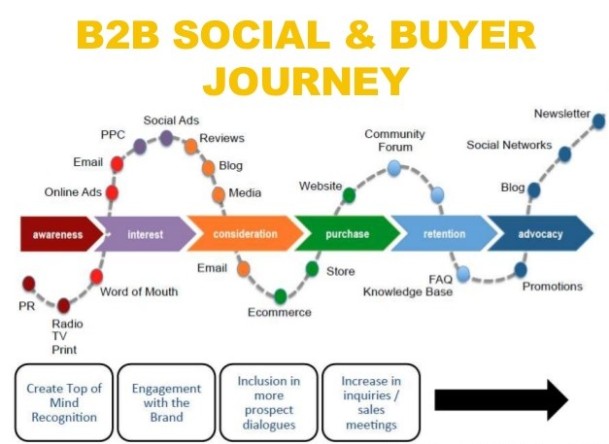
b2b-buyers-journey
B2B Buyers journey
The buyers journey can be condensed down to a three-step process: The Awareness Stage: The buyer realises they may have a problem. Consideration Stage: The buyer defines their problem and researches options to solve it and then the Decision Stage: The buyer chooses a solution.
Awareness.
In the Awareness stage, a buyer will identify an issue, or challenge they want to address. At this stage they decide what priority this issue or challenge should be. So, does your sales training cover off:
How would the buyer describe his or her challenges?
Where and how does the buyer educate themselves on the challenges facing others or their industry?
What would be the compelling reasons when the buyer comes to deciding whether or not this should be prioritised?
Consideration 
Next is the Consideration stage, here the buyer should have moved to having clearly defined the issue or challenge plus a commitment to dealing with it. They have self-educated, read whitepapers, interacted with companies and sales people plus will have evaluated the different options available to pursue the end goal of resolving the challenge. Again, sales training needs to address:
Which categories of solutions do buyers investigate?
Where do buyers educate themselves on the various options or solutions?
How do buyers perceive the pros and cons of each solution?
How do buyers decide which option is right for them?
Decision.
The third stage is Decision. The buyer has arrived at a decision on which solution matches their need.  Some questions the sales training material should cover:
What criteria or other considerations will a buyer use to evaluate the available offerings?
When the buyers comes to researching you (yes, they will) and your company’s offering, what do they like about what they see or read compared to the competition?
What concerns will you need to cover off on your solution?
Is there a buying committee or who else needs to be involved in the decision? For each person involved, how does their perspective on the decision differ?
What is the buying process or will the buyer have expectations around sampling/trying your solution before they purchase it?
What is the true cost of acquisition, so outside of buying your solution, do buyers need to make additional plans around implementation, IT or training?

Some sales training tips 

It is important to break down each step in your sales process and then match your sales training to the buyer’s journey. Each sales training session should focus on a step in the sales process including what sales assets, content and information to use. For a salesperson, learning the next step in the sales process should be a reward for mastering the previous one.
The buyer to supplier relationship along with how buyers engage with salespeople is changing rapidly. Your sales strategy , sales process and  sales training will have to become more dynamic, multi-channel and digitally driven, just like our customers.


Matching Sales Training to the Buyer’s Journey – Sales Training Solutions -The Bitter Business

Friday, 1 December 2017

Sales Strategy Presentation – Sales Training Solutions -The Bitter Business

Information on pulling together a sales strategy presentation, a template for what to include when developing your sales strategy plan with presentation guides and insights. An effective sales strategy presentation needs to consider what are your products and where or who is your market. It also plots out how the sales effort will be directed to ensure it captures profitable growth selling to customers. A sales strategy presentation should outline market and customer coverage with detailed plans that give the best possible opportunity for the business to win more customers. In more detail, a sales strategy defines the customer segments it wants to target and the business value propositions for each segment. Then it spells out how the sales force will be structured along with a documented selling processes.
sales-strategy-presentation
So a sales strategy is a business decision on 
  1. Who are you going to sell to.
  2. What are you going to sell them.
  3. How are you going to sell to them.
  4. What is your core sales and marketing messaging.
  5. What are your sales priorities.
  6. A clear set of goals that everyone will work toward.
Effective Sales Strategies are 100 percent aligned with the overall business strategy. They outline the ideal target clients, what is your value proposition, what are your success metrics, goals, roles, processes and specific actions required to meet targets. The sales strategy presentation must be based on the business and marketing plans so they all ties in together. It needs to outline in as much detail as possible – how will the sales and marketing team will deliver on objectives and the plan to target market segments. It covers how the sales team will they support marketing activities, such as inbound leads or promotional events.
Identify the Key Aims of the Sales Strategy.
The questions it should resolve and bring clarity to include, Is it to sell more to the same customer base? or Is it about market penetration or market development?. Also which target markets you are aiming for and the time, money and resources needed. These questions should be answered by researching when, where, how and why the existing customer base buys.


Set A Clear Market Strategy.
The sales strategy presentation needs to detail out questions in the plan such as;
Grow existing accounts?
Revenue with existing products?
Revenue from new products?
New revenue with existing products?
Up and cross-selling?
Retention plan?
Acquisition plan?
Customer mix?
Product mix?
Seasonal sales cycles?
Business growth depends on acquiring new, profitable business with different customers. Plan how you will approach every new customer. Maybe to win the business of a key customer, you may offer acquisition pricing, creating a loss-leader or maybe giving the product on a trial basis. Make sure you have a plan to move prices and margins back up to a profitable level, or else live with reduced margins from these customers.
Reaching the Customer and Target Market.
  1. Which sales channels will be most effective in selling to which customers.
  2. Do you sell direct or through channels?
  3. Map out the costs of each channel against the benefits it would bring.
  4. Implement a well-functioning funnel and opportunity planning process.
Sales Plans, Forecasting and the Annual Sales Budget.
The sales strategy presentation should include a detailed breakdown of the sales to be achieved each month, by customer and by product. The sales forecasts should be based on previous sales levels, or if a new business then the sales targets should be based on the business plan. It also takes into account information about customers’ buying habits, the sales cycle and other factors such as pricing and marketing activities.
Selling Resources Required to Meet the Plan.
The sales strategy is not just about sales, it also covers what resources are required to meet the plan. So it should document topics including – What is the Training plan. The plan to improve the customer experience. What (if any) specialist support is needed. What resources will be needed to make the sales force more productive.  What will the cost be of providing admin support so sales people spend more time on selling. Then it needs to call out all the marketing and sales assets in play and what needs to be created prior to launch the sales strategy.

Sales Strategy Presentation – Measuring Sales Performance.

Finally, the sales strategy presentation will give insight into how the sales performance will be measured against the plan. Areas to be included are;
Sales forecasting accuracy.
Cost of sale analysis.
Time and money spent on different customers.
Analysis of customer segments.
Insights into the win/loss ratio.
Salesperson productivity.
Channel productivity.
Lead to conversion ratio.
Cost per customer sale.
The return on sales costs.
In the business of selling, there are many of the factors that determine success which are outside of your control. So all the more reason you need to define your goals and tactics for meeting (and exceeding) your sales target. Writing a sales strategy presentation will help you take a more control in the fast paced world of sales.
Remember, the success of the sales strategy is the engine for the success for the whole company. It may sound simplistic but without acquiring and developing profitable customers, a business will eventually fail. Regardless of the size of a business, it’s critical to ensure your sales strategy presentation is clear, purposeful, with clear goals on what you want to achieve, and how you will serve your customers.  Learn more about Sales and Social Selling Training Strategy. 
This article was republished with permission of The Digital Sales Institute. Original article here:  https://www.thedigitalsalesinstitute.com/sales-strategy-presentation/


Sales Strategy Presentation – Sales Training Solutions -The Bitter Business

Friday, 29 September 2017

Why Social Selling Training Pays – The Bitter Business

Why Social Selling Training Pays – The Bitter Business

Selling and buying has changed. The profile of a typical business buyer along with their needs, values and how they purchase goods and services has altered completely from 10, even 5 years ago. A business should use social selling as a genuine touch point to share insights, research, information and content before engaging in any sales conversations. Social selling is a learned skill (how long does it take to master other sales tactics – months, even years?), it is not a fall back method for sales people to spam sales messages on Twitter, Facebook, on LinkedIn groups. Nor is it a means to plaster vanilla flavored sales messages across groups and connections.  The tactic of connecting and building a network of connections just to send sales messages is NOT social selling.
The biggest tip I can convey is that for social selling to work you need to build value over time with your social network by sharing relevant, quality content that people find useful and helpful. So, in time when a sales person reaches out with a personalized social touch point to a prospect to engage in a sales discussion, the chances of progressing a relationship will be greatly enhanced.


Monday, 10 April 2017

The Buyers Journey

The Buyers Journey – The Bitter Business


The Buyers Journey

the-buyers-whys
Increasingly the buyers journey is now done online. Even B2B customers have adopted consumer-like behavior. They now conduct product research online and often make purchasing decisions without a sales rep’s involvement. Those B2B customers who engage with sales agents are already 57 percent of the way through the buying process before their first contact. This fundamentally changes the type and tenor of the interactions that sellers use to engage with customers.
The most often used description of The buyer’s journey is, ” the process a buyer will go through to become aware of, consider and decide to purchase a new product or service. This journey can be condensed down to a three-step process: The Awareness Stage: The buyer realizes they may have a problem. Consideration Stage: The buyer defines their problem and researches options to solve it and then the Decision Stage: The buyer chooses a solution. 

buyer-journey-quote


During the Awareness stage,  a buyer will identify an issue, or challenge they want to address. At this stage they decide what priority this issue or challenge should be. So ask yourself?
How would the buyer describe his or her challenges?
Where and how does the buyer educate themselves on the challenges facing others or their industry?
What would be the impact of non action by the buyer?
In your (the sales person or marketing) business, what are the common misconceptions a buyer could have in relation to addressing the issue or challenge?
What would be the compelling reasons when the buyer comes to deciding whether or not this should be prioritized?

At the Consideration stage, the buyer should have moved to having clearly defined the issue or challenge plus a commitment to dealing with it. They have self educated, read whitepapers, interacted with companies and sales people plus will have evaluated the different options available to pursue the end goal of resolving the challenge. Ask yourself:
Which categories of solutions do buyers investigate?
Where do buyers educate themselves on the various options or solutions?
How do buyers perceive the pros and cons of each solution?
How do buyers decide which option is right for them?
Lastly, at the Decision stage, the buyer have arrived at a decision on which solution matches their need.  Some questions you should ask yourself to define this stage are:
What criteria or other considerations will a buyer use to evaluate the available offerings?
When buyers comes to investigating you (yes, they will) and your company’s offering, what do they like about what they see or read compared to the competition?
What concerns will you need to cover off on your solution?
Is there a buying committee or who else needs to be involved in the decision? For each person involved, how does their perspective on the decision differ?
What is the buying process or will the buyer have expectations around sampling/trying your solution before they purchase it?
What is the true cost of acquisition, so outside of buying your solution, do buyers need to make additional plans around implementation, IT or training?
The answers to these questions will provide a robust foundation for your own buyer’s journey